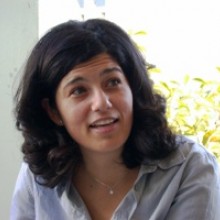
Paraskevi Pouli is a Senior Application Scientist at IESL-FORTH, Photonics for Heritage Science group, in charge of developing novel laser technologies for restoration of art and antiquities. She holds a degree in Physics from Aristotle University of Thessaloniki, Greece and a Ph.D. in Physics from Loughborough University, UK. Her PhD thesis, entitled “Laser cleaning studies on stonework and polychromed surfaces”, was supervised by prof. D.C. Emmony.
She joined IESL-FORTH in 2000, focusing her research on investigating laser ablation of CH materials and developing laser-cleaning methodologies for practical applications. In recent years, she has engaged in research that utilizes advanced spectroscopic, imaging, and photoacoustic techniques to assess, optimize and monitor the cleaning process. Additionally, she has worked on documentation and semantics for data recording, reuse, and integration. Lastly, she has explored machine-learning algorithms to facilitate decision-making in laser cleaning.
She is involved in a number of EU (Η2020-IPERION-HS, H2020-HERACLES, H2020-IPERION-CH, FP7-CHARISMA, FP5-PROMET, etc.) and nationally (CALLOS, KRIPIS-POLITEIA I and II, LASTOR, MOBILART, CRINNO-II etc.) funded research projects.
Her research has been published in over 80 publications (6 invited) in peer reviewed journals and conference proceedings, reflecting in about 1130 citations (WoS) while she has been presenting her work in major international conferences and workshops in the field. In 2009 she joined the International scientific committee of LACONA Conferences, while she has been also actively contributing in the organization of several other conferences.
Since 2012 she serves as technical manager of the “OPTO-CH” training activities initiated by IESL-FORTH. Over the past few years she is vigorously participating to EU and national initiatives on the development of E-RIHS and E-RIHS.gr Research Infrastructures focused in the field of Heritage Science.
In 2001 she undertook, on behalf of IESL-FORTH, the laser-cleaning projects on the Athens Acropolis. In this context the Acropolis Museum and IESL-FORTH have been awarded the 2012 Keck Award by the International Institute for Conservation of Historic and Artistic Works (IIC) for their collaboration regarding the “Laser rejuvenation of Caryatids opens to the public at the Acropolis Museum: a link between ancient and modern Greece”.
Education
- 2000, PhD, Physics Department, Loughborough University, UK
- 1995, BSc, Physics Department, Aristotle University of Thessaloniki, Greece
Interests
- Investigation of laser ablation mechanisms & development of cleaning methodologies on a variety of Cultural Heritage challenges
- Understanding & prevention of side effects upon laser cleaning; i.e. yellowing of sensitive substrates & blackening of pigments.
- Optimization of the cleaning process using novel & prototype laser systems & methodologies
- Assessment, optimisation and monitoring of the laser cleaning intervention via advanced spectroscopic, imaging, and photoacoustic techniques
- Documentation and semantics for data recording, reuse, and integration
- Investigation of machine-learning algorithms to facilitate decision-making in laser cleaning
Awards/Prizes/Distinctions
- 2012 Keck award of IIC (https://www.iiconservation.org/keck-awards)
- 2022 Chinese Embassy in Greece "Outstanding Contribution Award" for the collaboration of IESL-FORTH with the Palace Museum, to develop a joint laboratory in Beijing (50th anniv. of the establishment of diplomatic relations China - Greece)